From reporting to reality
Most ESG strategies still rely on aggregated data, estimates, and delayed indicators. These frameworks are useful for compliance and governance, but they rarely provide operational clarity at the level where performance is actually created.
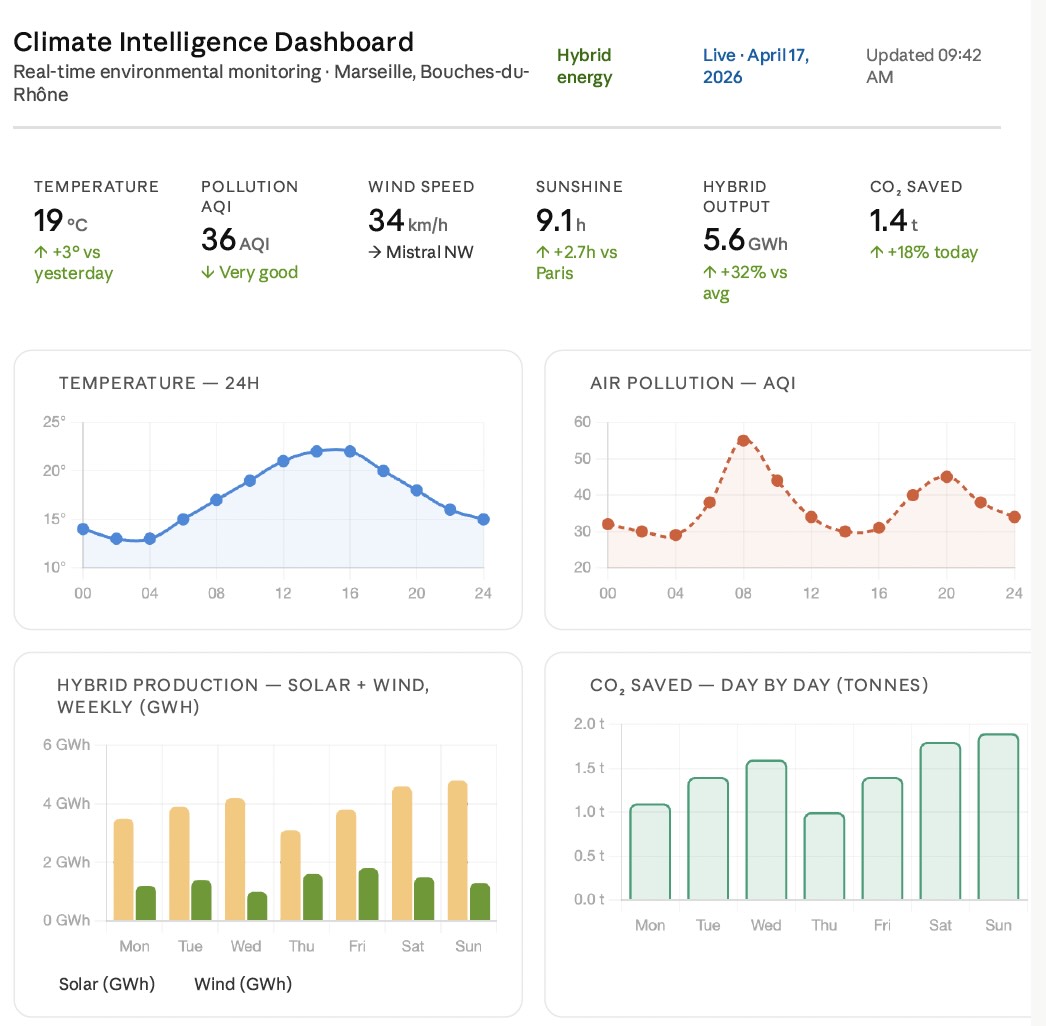
This creates a structural gap. Organizations announce sustainability goals, publish dashboards, and report progress, yet often lack continuous visibility into how those commitments translate on the ground.
Closing that gap requires a shift: from ESG as a reporting layer to ESG as an operational layer.
Why visibility changes the equation
When ESG performance becomes visible at the site level, it becomes actionable. Operators can understand local production, energy dependency, environmental conditions, and their direct effect on emissions, resilience, and operating quality.
That changes decision-making. Instead of measuring outcomes retrospectively, organizations can improve performance continuously. Instead of relying mainly on modeled assumptions, they can rely on real-world signals.
Visibility turns ESG from a narrative into a management tool.
Infrastructure as a source of ESG data
Distributed energy infrastructure is uniquely positioned to support this transition. When on-site generation is combined with sensing, connectivity, and continuous monitoring, it creates a live stream of environmental and operational data.
Each deployed asset becomes more than an energy source. It becomes a measurable node — capturing production, operating context, and environmental conditions in real time.
Over time, this creates a network of visible ESG performance across multiple sites and operating environments.
From compliance to competitive advantage
As ESG expectations rise, the ability to demonstrate real performance becomes a differentiator. Investors, regulators, partners, and clients are increasingly looking for evidence that is credible, auditable, and connected to actual operations.
Organizations that can provide that visibility move beyond compliance. They strengthen risk management, improve operational discipline, and communicate value with greater credibility.
In that sense, visible ESG performance is not only a sustainability issue. It is becoming a strategic advantage.
A more credible ESG standard
The next generation of ESG will be built on measurable infrastructure, better context, and more direct observation. Reporting still matters, but its value increases when it is supported by physical systems that make performance tangible.
Visibility is the foundation. Without it, ESG remains largely declarative. With it, ESG becomes operational, credible, and scalable.