
Infrastructure investment has a long memory. The assets that define a generation of allocators — highways, power grids, water networks, telecoms towers — were built to do one thing reliably for decades. Predictability was the point. The asset produced a service, the service generated a cash flow, the cash flow justified the capital.
That logic still holds. But it is no longer complete.
The most consequential infrastructure assets of the next decade will not only deliver a service. They will also generate data — continuously, at scale, from their physical position in the world. And that data layer, compounding over time across a distributed network, will become a second asset embedded inside the first.
The question for infrastructure allocators is not whether this is happening. It is whether their current deployment strategy positions them to benefit from it.
The data deficit in physical infrastructure
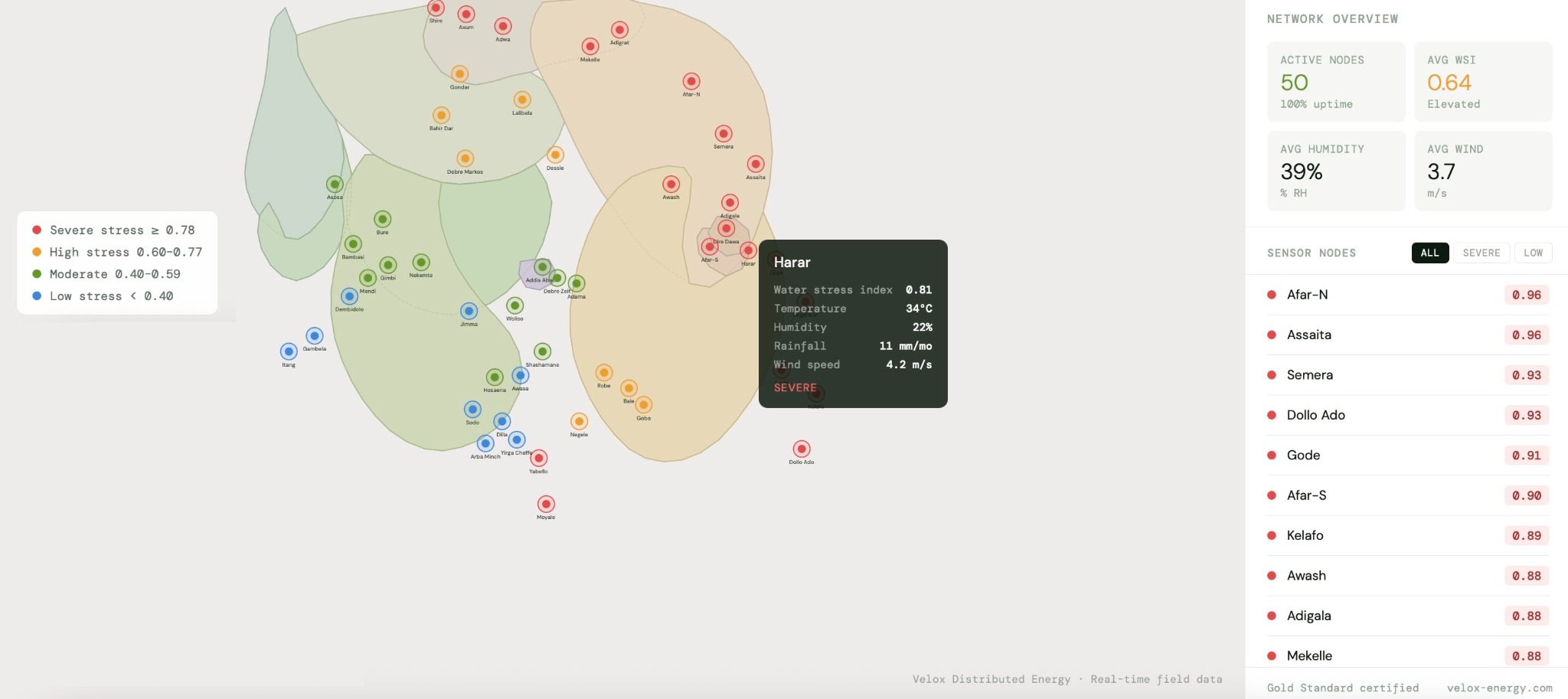
Physical infrastructure sits at one of the most data-rich intersections imaginable: real-world environments, operating continuously, at locations that matter. A wind turbine in a coastal industrial zone, a distributed energy asset on a hotel roof in East Africa, a hybrid installation in a port facility — each of these is, by definition, a sensor in a location where environmental and operational data has genuine value.
And yet, most infrastructure deployments capture almost none of it.
Energy is generated and metered. Carbon is estimated from grid factors. Environmental conditions are modelled from regional datasets. The asset does its job — reliably, predictably — and the intelligence it could be producing is left uncaptured.
This is not a technology problem. The instrumentation required to generate continuous environmental data from a distributed infrastructure asset — wind speed, temperature, humidity, solar irradiance, air quality, atmospheric pressure — is neither expensive nor complex. It is an architectural choice. Infrastructure designed with a data layer produces data. Infrastructure designed without one does not.
The gap between infrastructure that produces energy and infrastructure that produces intelligence is widening.
What a data layer actually produces
The value of environmental data generated by distributed infrastructure is not abstract. It is specific, addressable, and increasingly in demand across several distinct markets.
Climate and risk modelling
The dominant limitation of current climate risk models — whether used by insurers, reinsurers, or financial regulators — is the quality of ground-truth data at the local level. Satellite data provides coverage. Weather station networks provide sampling. But neither provides the density, continuity, and geographic specificity that a distributed infrastructure network can generate.
ESG and compliance reporting
As mandatory climate disclosure frameworks tighten — TCFD, CSRD, SFDR, and the regulatory pipeline that follows — the demand for site-level, auditable environmental data is growing faster than the supply. Estimated figures derived from regional averages are losing credibility with auditors, rating agencies, and institutional investors.
Operational intelligence
For industrial operators, logistics platforms, and real estate asset managers, continuous environmental monitoring at the site level enables decisions that aggregate data cannot support: when to schedule energy-intensive processes, how to manage microclimate conditions in facilities, how to anticipate and respond to environmental events before they affect operations.
Carbon markets
When environmental measurement is conducted under a recognised independent certification framework — such as the Gold Standard — it creates a verifiable audit trail for carbon accounting. That trail supports the generation of tradeable carbon credits, the integrity of Scope 1 and Scope 2 reporting, and the credibility of green finance instruments.
The compounding dynamic
What distinguishes a data-generating infrastructure network from a portfolio of individual assets is the compounding dynamic that emerges at scale.
A single deployed asset produces useful local data. Ten assets across a region produce a dataset with interpolation value — the ability to model conditions between measurement points, not just at them. A hundred assets across multiple geographies produce something categorically different: a proprietary, continuously updated, ground-truth dataset with the density and coverage to support commercial applications that no individual operator or national weather service can replicate.
Each new deployment adds to the network. Each addition increases the value of every existing node. The data asset — unlike the energy asset — does not depreciate. It appreciates.
This is a dynamic that infrastructure investors understand well in other contexts. Toll road networks become more valuable as the network extends. Fibre networks compound as density increases. The same logic applies here — but with a dataset as the network effect, rather than a physical connection.
A different way to think about infrastructure returns
The conventional infrastructure return model is built around a single cash flow: the service the asset delivers, priced against the cost of delivering it, discounted over the asset life. It is a model optimised for single-purpose assets in stable regulatory environments.
Hybrid infrastructure with an embedded data layer does not fit cleanly into that model — and that is precisely the point. It participates in multiple revenue streams simultaneously: energy generation, carbon certification, SaaS data subscriptions, and environmental reporting services. Each stream has a different risk profile, a different growth trajectory, and a different relationship to the underlying physical asset.
The blended return profile that results is not simply additive. It is more resilient — because no single market downturn affects all four streams simultaneously — and more optioned — because the data asset creates exposure to markets that are growing faster than the energy market itself.
The most valuable infrastructure assets of the next decade will not be the ones that deliver the most energy. They will be the ones that generate the most intelligence from doing so.